Introduction
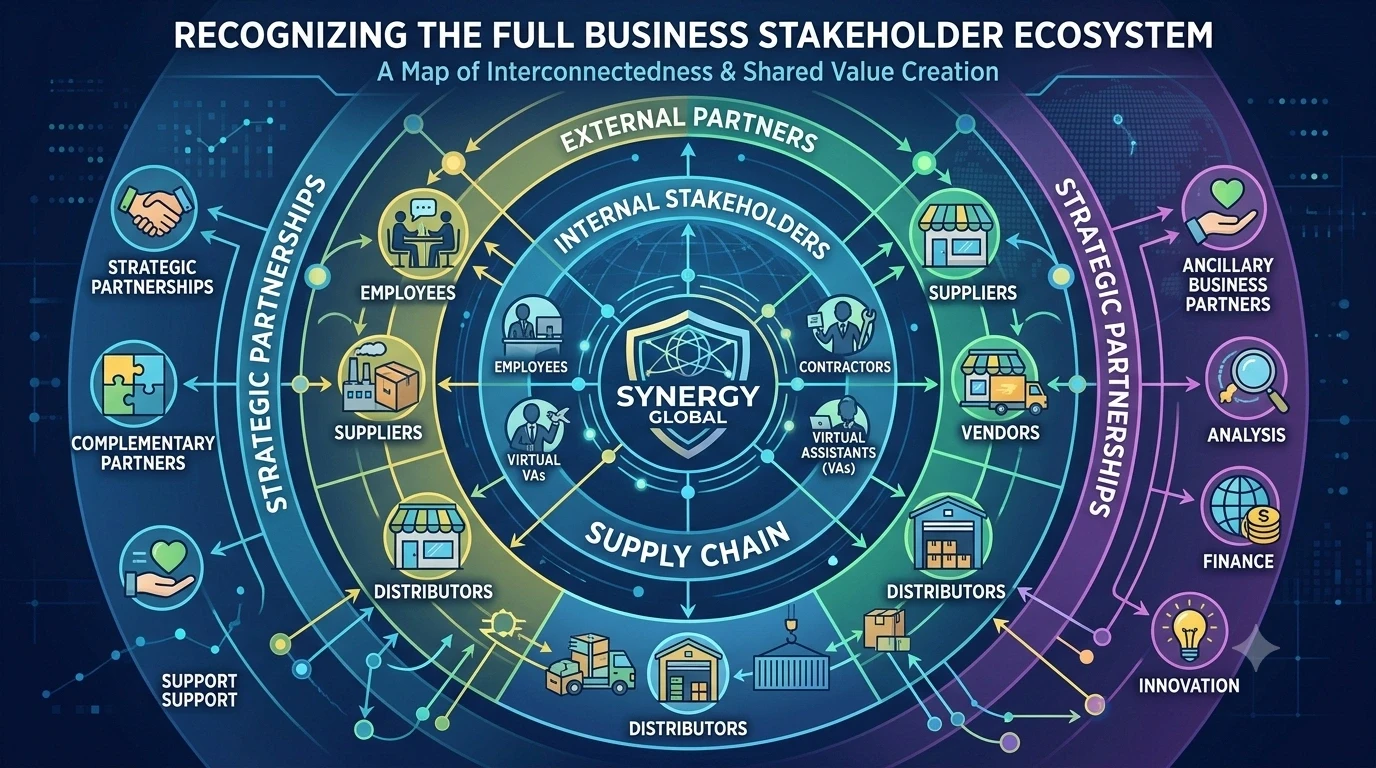
Ask a founder to describe their business's ecosystem, and the answer is almost always the same two words: employees, customers. It's a reasonable instinct — those are the relationships with the clearest line to revenue. But that answer leaves out most of the network a business actually depends on to keep its promises: the contractors and virtual assistants doing the work, the suppliers and vendors providing materials, the distributors moving product, and the complementary businesses that could be sending referrals but aren't.
The Problem
The businesses most owners run touch far more people than "employee" and "customer" capture. Every one of those additional relationships is being managed somehow — through prompt or late payment, through generous or grudging dispute resolution, through recognition or silence. When they're managed by default rather than intention, the result is a slow accumulation of quiet resentment that eventually surfaces as reputational damage, in places a business rarely thinks to look.
Why It Matters
A trade's word-of-mouth network moves independently of any customer-facing marketing a business runs. Contractors talk to other contractors. Suppliers talk to other suppliers. When a business treats those relationships poorly — late payments, disputed invoices, indifference — that network starts working against the business, often before its leadership notices anything is wrong. The reverse is equally true: a business that treats its non-customer stakeholders with consistency and respect builds an unofficial sales force that costs nothing beyond the attention it takes to maintain.
Key Lessons
Neglected relationships can talk a business out of growth before it starts. One communications company spent three years losing money, and the cause traced back not to weak customer demand but to how it treated its subcontractors. Specialized trade contractors — the kind of people who compare notes constantly — were actively warning colleagues away from the business over late payments and disputed invoices.
The same relationship, treated differently, becomes an asset. The company's fix was straightforward: pay on time, let old late fees go, and treat its smallest contractors with the same respect given to its largest vendors. Within a year, the same people who had been warning others off the business were recommending it — to customers directly, not just to each other. Net income turned positive for the first time in three years. The company was later acquired.
Recognition aimed at individuals outperforms recognition aimed at organizations. In distributor and reseller relationships especially, results are rarely driven by an organization as a whole — they're driven by one or two people inside it who go out of their way. Naming that person specifically, rather than thanking "our valued partners" collectively, is what turns a transactional relationship into a loyal one. Companies don't generate referrals. People do.
Physical recognition lasts; digital recognition doesn't. A message of thanks sent digitally has an effective lifespan measured in seconds before it's buried by the next notification. A card someone can hold, or a gift that sits on a desk, doesn't have that problem — it stays visible for weeks, which means the relationship stays top of mind for weeks too.
Practical Framework
There's a simple distinction that determines whether a gift builds a relationship or just advertises a company: who it's about. A branded item carrying only a company's logo is, functionally, an advertisement — it's about the company that gave it. The same item with the recipient's name on it becomes theirs, something that happens to carry a company's logo rather than exist primarily to promote one. Only the personalized version earns a lasting place in someone's daily environment.
This same logic extends to the sequence of outcomes recognition sets in motion. Recognizing a supplier consistently builds reliability, which becomes reputation. Recognizing a referral partner specifically produces referrals from parts of a network that were previously silent. Each stage feeds the next — none of it depends on running another customer-facing campaign.
Implementation
Putting this into practice starts with a mapping exercise rather than a new ongoing program. A business owner lists every stakeholder group the business depends on — employees, contractors, VAs, suppliers, distributors, referral partners, and complementary businesses in adjacent industries. From that list, three relationships outside the customer base stand out as ones the business relies on most. Each of those three receives something real and personal — a handwritten card, or a gift carrying their name — within the same week the exercise is done.
Common Mistakes
The most common mistake is treating non-customer relationships as pure cost lines: a payment made, an invoice processed, nothing more. A close second is defaulting to digital recognition because it's fast and free, without accounting for how quickly it disappears. A third is recognizing organizations instead of the specific people inside them who actually drive results — a mistake that leaves the most valuable relationships in a partner network feeling anonymous.
Action Steps
Write down every stakeholder group the business touches, beyond employees and customers.
Identify the three non-customer relationships the business depends on most.
Send each of those three a personalized, physical gesture this week — a card, or a gift with their name on it.
Review payment and dispute-resolution practices with contractors and vendors for patterns that could be quietly damaging trust.
When recognizing a partner organization, name the individual person responsible for the result, not just the company.
Conclusion
The relationships a business treats as overhead — contractors, suppliers, distributors, referral partners — are often its most underused growth channel. Recognition applied broadly and personally, rather than reserved for customers alone, compounds into reputation, referrals, and revenue without requiring a larger marketing budget. The businesses that grow fastest aren't necessarily the ones with the biggest customer campaigns; they're the ones paying attention to every relationship it takes to keep their promise.