Introduction
Almost every service business has a list it isn't using well. It might be a CRM full of past clients, a newsletter that goes out when someone remembers, or a stack of business cards from events. The owner knows there is revenue in it somewhere. The emails that do go out get a few opens, fewer replies, and the occasional unsubscribe, and the conclusion follows: email doesn't work anymore.
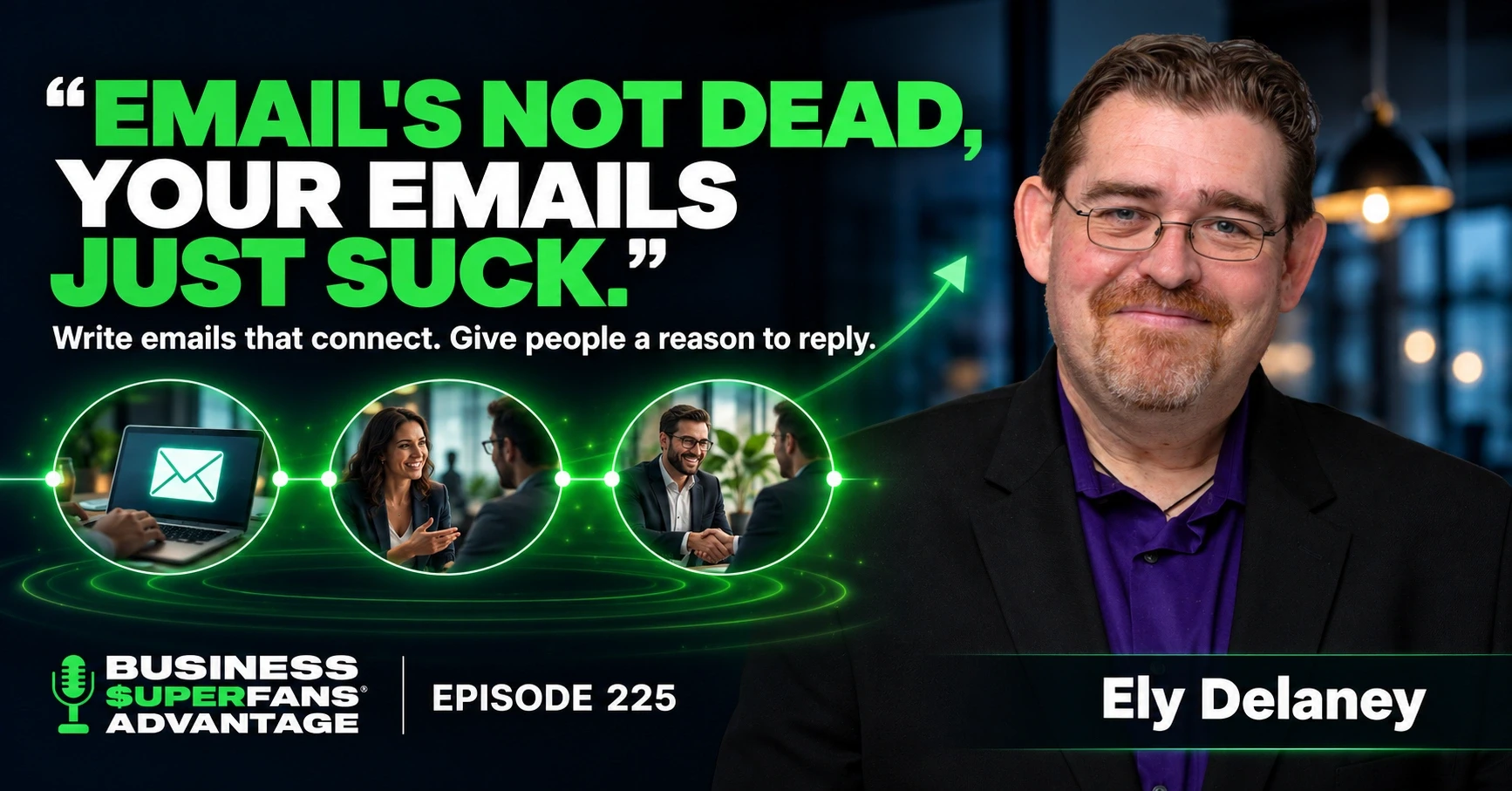
Ely Delaney, founder of Purple Knight Marketing and author of The Follow-Up Code, hears that conclusion all the time, and he has an answer printed on the back of his book: "email's not dead, your emails just suck."
That line is blunt, but the idea behind it is generous. The channel is fine. People still read messages from people they like and trust. What fails is follow-up built around the sale instead of the relationship.
This article draws on Frederick Dudek's conversation with Ely Delaney on Business Superfans® Advantage, Episode 225: How to Turn Your Email List Into Paying Clients by Following Up Like a Human with Ely Delaney.
The Problem: Follow-Up That Only Asks
Most follow-up is written with one goal: get the next sale. Every message carries an offer, a deadline, or a request for a call. Over time, recipients learn the pattern, and they respond the way anyone responds to a pattern they don't enjoy. They stop opening.
Delaney describes how far this has gone. People see a salesperson's name on their phone and send it to voicemail, because they know a pitch is coming. They avoid "book a call" offers, because, in his experience, too many strategy sessions have turned out to be a long sales pitch. The tools didn't create the problem. The habit did.
Frederick Dudek, a Business Prosperity Advisor and author of Creating Business Superfans, has a recent example from the receiving end. A vendor approached him about a collaboration, then spent the call pitching a service that didn't fit how his platform worked, and kept pitching after he explained why. The vendor wasn't listening, and every message after that call would have been read through that experience.
Why It Matters: Buyers Arrive on Their Own Schedule
The deeper reason pitch-first follow-up fails is timing. A business is ready to sell all the time. A buyer is ready only when their situation changes. That might be tomorrow. It might be a decade from now.
Delaney has a story that makes the point. A man heard him speak in Scottsdale, Arizona, on July 3, 2010. On September 16, 2020, the same man emailed him: his son was starting a construction company, and could Delaney help with marketing? More than ten years had passed. Delaney had never sold him anything.
The goal of follow-up, as Delaney puts it, is to strengthen the relationship to the point where "when they're ready, you're the first person they think of." No single email achieves that. Consistency does. And consistency is only possible if each message is something the recipient is glad to get.
Key Lessons
Lesson 1: Lead with value and make the sale an afterthought
Delaney's emails rarely sell. They share something: a book that helped him, an idea worth trying, something "cool" he wants to pass along. He has recommended Bob Burg's The Go-Giver for years, a book about walking into a room asking who you can help rather than who will give you money.
The payoff shows up two ways. First, people reply even when they aren't buying. They write back to say an idea sounds great but they aren't ready yet, which keeps the conversation alive. Second, when Delaney does have an offer, people pay attention. A list trained to expect value reads the rare pitch. A list trained to expect pitches reads nothing.
Sometimes the value lands harder than expected. After Delaney recommended Og Mandino's The Greatest Salesman in the World, one reader wrote to tell him she had been ready to quit. She bought the book, read it over a weekend, and told him it had saved her business. Nobody can buy that kind of loyalty, and she is likely to tell others.
Lesson 2: Write the way you talk
Most business writing sounds like nobody in particular. Delaney's explanation is that people write the way their English teacher taught them, not the way they talk, and that style produces no emotional response.
His work, whether ghostwriting for clients or coaching them, is to get an owner's personality, stories, style, quirks, and experiences into their words. The response he is aiming for doesn't have to be dramatic. It might be "I like this guy," or "she always sends cool stuff," or "I feel like she's talking to me."
The results can be large. One of Delaney's clients came to him for CRM help. He had more than 5,000 people on his list, poor open rates, and emails Delaney describes as hypey, pitchy, and gruff. His weekly in-person workshop, his main source of leads, was struggling to draw 30 people. Over about six months, they reworked how he communicated. Delaney says the client went from roughly $30,000–$35,000 a month to about $110,000, and his workshop grew until he knocked out a wall to hold 100 people; a bad week became 75. Delaney's summary: "We just changed the language. We just changed how we communicated."
Lesson 3: Restart cold relationships with honesty, not an offer
When a list has heard nothing for months, the instinct is to come back with a big offer. Delaney recommends the opposite. The first email in what he calls a bring-them-back campaign has the subject line "I'm such a slacker." It admits you haven't stayed in touch the way you should, apologizes, promises to do better, and asks what's new and exciting in their world. Then you sign it. No template, no graphics.
Delaney says one client sent it on a Monday and asked him on Tuesday how to stop the rest of the campaign, because everybody had replied. Her calendar filled for the next 30 days, and she made over $12,000 in sales by Friday from an email that sold nothing. Another client told him she had received more replies in three weeks than in her previous four years in business, some from people who had been on her list for years without a word.
Lesson 4: Make it easy to start a conversation
An email that gets no reply isn't a dead end. Delaney's simplest technique is a phone call a day or two after sending something (about a week after sending something by mail) to ask whether it arrived. "Did you get the thing?"
The question carries no pressure, so people answer it. Often they haven't seen it, and they go looking. Sometimes they apologize for being busy. Either way, a conversation has started that a second email would never have produced. Delaney notes that a CRM can tell you whether an email was opened, but that isn't the point; the call is a reason to talk.
He also warns against quitting early. He has followed up with a prospect eleven times and heard yes on the twelfth, with a thank-you for staying on them.
Lesson 5: Treat every relationship as two-way
Follow-up isn't only for prospects. Delaney applies the same principles to referral partners, vendors, and the guests and hosts on podcasts. If he sends someone two or three referrals and never hears a thank-you, he probably stops. If a host treats guests as free promotion, or a guest acts as if the host should be honored to have them, both lose. "Everybody needs to put their ego in a pocket somewhere," he says.
Dudek makes the same point from the business ecosystem side: suppliers, contractors, distributors, and complementary businesses are often the front line with customers. In Creating Business Superfans, he writes that people will crawl through broken glass for appreciation and recognition. A thank-you is the cheapest follow-up there is.
Practical Framework: Value, Voice, Persistence
Three questions test whether follow-up is building relationships or wearing them out:
Value. Would the recipient be glad to get this message even if they never buy?
Voice. Does it sound like a specific person, or like any business in the industry?
Persistence. Will I still be in touch with this person a year from now, and five years from now?
A message that passes all three can go out often. A message that fails them, especially the first, spends trust.
Implementation: The Next Two Weeks
Day 1: Pick the forgotten. Pull a list of past clients and prospects you haven't contacted in three months or more.
Day 2: Send the honest restart. Write a short, plain email in your own voice: you haven't stayed in touch, you're sorry, you'll do better, what's new in their world? No offer.
Days 3–7: Answer everyone personally. Every reply is a conversation. Respond as yourself.
Week 2: Share one useful thing. A book, an article, a tool, or an idea that helped you. No pitch attached.
Week 2: Call five people. For five people who didn't reply, call and ask whether they saw what you sent.
Ongoing: Thank every referral. Make a thank-you the automatic first step whenever someone sends business your way.
Common Mistakes
Pitching in every message. It trains people to ignore you.
Writing like a company. Generic language creates no emotional response.
Overproducing re-engagement emails. Templates and graphics make an apology look like marketing.
Relying on open rates instead of conversations. Data tells you what happened; a call starts something.
Giving up after two or three tries. Buyers' timing is theirs, not yours.
Forgetting the people who send you business. Referral partners stop sending when they feel unappreciated.
Signing friends as clients without thinking it through. Delaney's rule: "Friends make horrible clients, but clients can become amazing friends."
Action Steps
Read your last five follow-up emails and count how many asked for something.
Rewrite one of them the way you would say it out loud.
Send a plain, honest restart email to contacts you've neglected.
Share one genuinely useful resource with your list this month.
Call five non-responders to ask whether they got it.
Thank every person who has sent you a referral in the past year.
Conclusion
Follow-up doesn't fail because people stopped reading email. It fails when every message asks and none of them give. The businesses that turn lists into clients send value, write like people, and stay in touch for as long as it takes, because they know the buyer will decide when the time is right. When that moment comes, the goal is simple, in Delaney's words: "when they're ready, you're the first person they think of."