BUSINESS SUPERFANS® ADVANTAGE • EPISODE 215
Sales

Revenue Reactor Discipline
Sales
Blocked Growth Addressed
The primary revenue leak is weak engagement at first-contact touchpoints — trade show booths, virtual sales calls, live presentations — where unclear positioning and passive interaction let a crowd's attention, and a potential customer, walk right past the business's message.
Primary Stakeholder
Customers
Additional Stakeholders
Prospects
Primary Topic
Audience Engagement & Attention Capture (Trade Shows and Sales)
DIRECT ANSWER
To capture audience attention, build authority first — through positioning, tone, and confident body language — then create genuine engagement by asking questions and acknowledging what the audience already cares about instead of reciting a scripted pitch. Anders Boulanger calls this "co-creating an experience," and it's what turns passersby and prospects into buyers.
Why This Guest’s Perspective Matters
Anders Boulanger has spent over four decades combining a professional magic career (started at age five, trained under mentor Joel Bauer) with trade show and sales engagement strategy, building Engagify into a company trusted by major brands including Microsoft, and codifying his methods in Engage First (October 2025).
Key Discoveries From This Conversation
The Curse of Knowledge — Subject matter experts often can't communicate simply because they assume shared context with their audience, leading to disengaged rooms (illustrated by Frederick's own Eaton Corporation training face-plant and a client presentation in Germany that lost the room before a software crash forced a reset).
Crowd Psychology and Leverage — "Nothing attracts a crowd like a crowd." Filled seats signal credibility and pull in more people; empty seats signal failure before a word is spoken.
Theater Facilitation — Pairing an entertaining MC/infotainer with dedicated engagement specialists working the floor dramatically outperforms a single presenter making cold announcements to an empty room, as demonstrated in Engagify's work with Microsoft's trade show booths.
Authority Positioning — Physical elevation, vocal tone (pitch, EQ), and framing (how a speaker is introduced) all shift how much an audience is willing to listen.
Quality Within Quantity — An engaging one-to-many presentation with built-in qualifying moments ("raise your hand if...") filters a broad trade show crowd down to genuinely interested prospects without sacrificing volume.
Pre-Performance Rituals — Vocal warm-ups, physical priming, and "olfactory anchors" (a scent deliberately tied to a peak-performance memory) help sellers enter a high-energy state before a call, correcting for the flat default energy of virtual selling.
Co-Creating vs. Presenting — Reframing a sales conversation as a shared, responsive experience — acknowledging the audience's stated objectives in real time — builds trust and shortens the path to close.
Lead with authentic engagement, not gimmicks. Engagify's name comes from "authentic interactions" — audiences can feel when a company is genuinely present, and that presence is what earns attention and trust.
Fill the room before you sell to it. Nothing attracts a crowd like a crowd — get a few people engaged first through entertainment or an interactive hook, and momentum brings in the rest.
Knowing something doesn't mean you can teach it. Being an expert (or hiring one) isn't enough — teams need explicit training in explaining things simply, or they risk losing an audience even with a great product.
Acknowledge objectives before you pitch. Opening a conversation by asking what the other person wants — then referencing it throughout — builds trust and closes deals faster than a rehearsed script.
Build super fans on the front line, not just at the top. Investing relationship time with the people who actually use or sell your product creates internal champions who open doors a top-down relationship can't.
Treat your state like a performer would. A vocal warm-up, physical priming, or a personal "anchor" ritual before a call combats the low-energy default of virtual selling and puts you in a more persuasive state.
When something breaks, neutralize it before you rebuild. Naming a visible failure out loud — rather than pretending it didn't happen — can reset an audience's confidence and set up a stronger close.
01:11 — How Engagify started and why "AI" means authentic interactions — Understanding the philosophy behind capturing attention without gimmicks.
03:51 — From magician to trade show strategist — How performance skills became a repeatable engagement system.
13:34 — The Microsoft case study: theater facilitation — Why pairing an MC with engagement specialists fills seats and builds crowds.
19:22 — Finding quality within quantity — Using qualifying questions to convert a mixed trade show crowd into real leads.
26:48 — Neutralizing a mid-presentation failure — Turning a software crash into a trust-building moment and a bigger sale.
29:50 — Anders' book, Engage First, and the engagement drivers inside it — Authority, tone of voice, and positioning as sales tools.
36:14 — Pre-call rituals and olfactory anchors — Getting into a high-performance state before a sales call or presentation.
43:26 — Getting out of your own way — Why preparation, not talent alone, creates business super fans.
PUT THIS INTO PRACTICE
Before your next sales call, presentation, or trade show shift, spend two minutes on a deliberate pre-performance ritual — a vocal warm-up, a few pushups, or recalling your last genuinely great call — so you walk in at a higher-energy state instead of the flat default most virtual sellers bring. If it's a live conversation, open by asking the other person what they want out of it, and reference that goal explicitly before you close. Want a structured way to find where your own engagement is leaking revenue? Get your free Revenue Leak Score at RevenueReactor.AI.
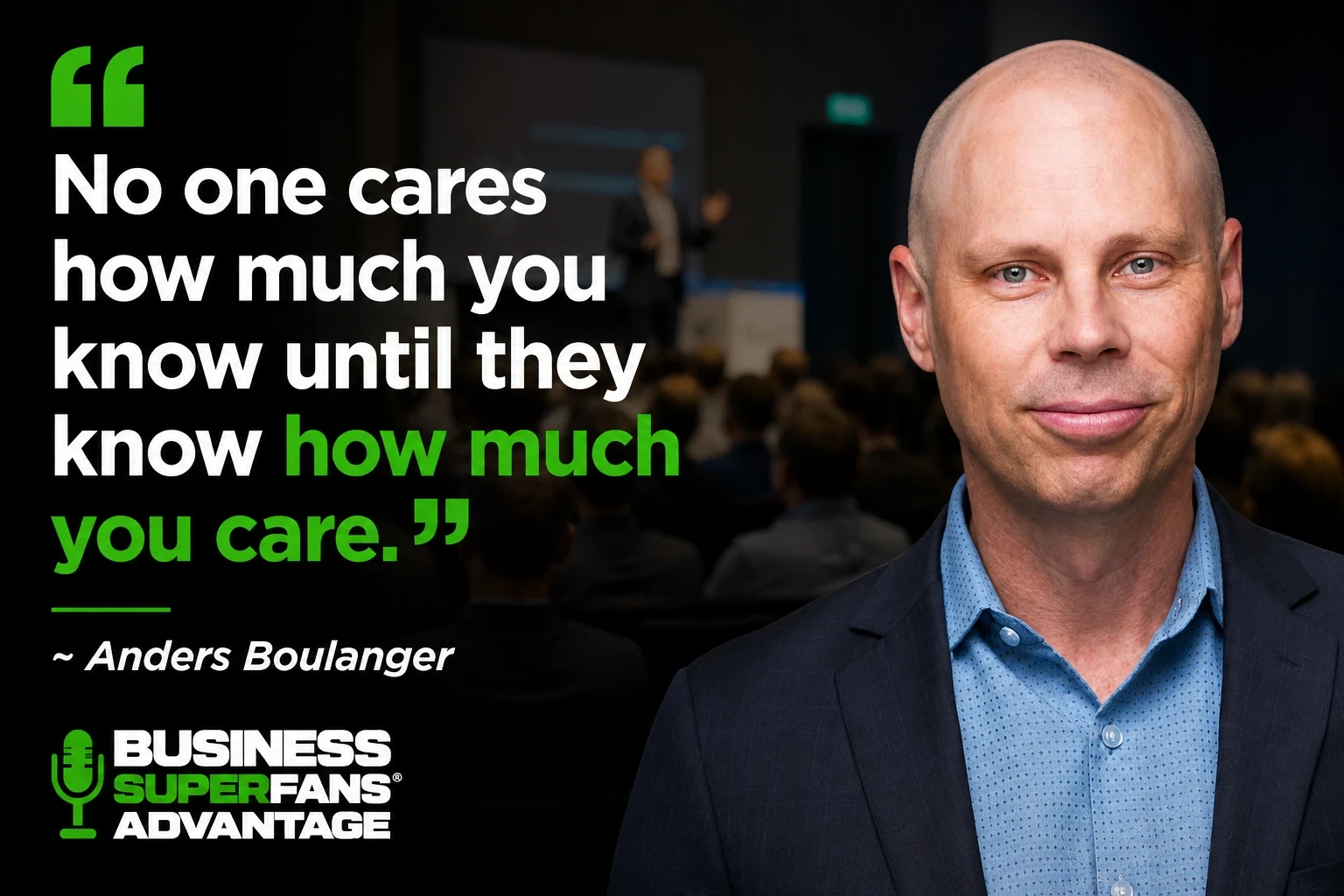
Anders' story lands because it mirrors something I lived for years running distributor channels and trade show booths around the world. The line that stuck with me was "no one cares how much you know until they know how much you care" — the same principle that let me build super fan relationships with the frontline technicians and salespeople actually moving my product, not just the owners I was contractually obligated to court.
What Anders adds is the system behind that instinct: authority positioning, tone, crowd psychology, and pre-performance rituals that turn "winging it" into something repeatable. His point about neutralizing a visible failure especially resonates — I once reset a room in Germany by simply acknowledging a software bug out loud instead of hiding it, which rebuilt trust and led to a much bigger sale. That's Recognition working in real time: once an audience trusts you're honest about a failure, they'll actually listen to what comes next.
If you're running trade shows, virtual demos, or sales calls and you've never audited how you open the room, this episode is your blueprint.
How do you capture audience attention at a trade show? You capture trade show attention by creating leverage — using an entertaining presenter to draw and hold a crowd while dedicated engagement staff invite people in one by one, since nothing attracts a crowd like a crowd, and empty seats signal failure before you've said a word.
How do you build trust with a customer or audience quickly? You build trust quickly by acknowledging what the other person actually wants before you present anything — asking their objectives, referencing them throughout the conversation, and positioning yourself with confident tone and body language, rather than reciting a rehearsed pitch at them.
What is an olfactory anchor and how does it help sales performance? An olfactory anchor is a scent deliberately linked to a peak-performance memory. Anders Boulanger recommends smelling it right after a great call so the brain associates that scent with a high-energy state, then using it before future calls to recreate that state on demand.
Why do knowledgeable experts sometimes fail to engage an audience? Knowledgeable experts often fail to engage an audience because of the "curse of knowledge" — they assume others share their context, skip over foundational details, and speak at a pace or depth suited to peers rather than the audience actually in front of them.
Engagify (engagify.ai) — Anders Boulanger's company for trade show infotainment, booth staff training, and virtual engagement training.
Engage First (book, October 2025) — available on Amazon and engage-first.com; includes free "Fundamental Five" training and "Four Ways to Be More Engaging" download with purchase.
Joel Bauer — Anders' mentor, credited with teaching him how to translate performance skill into a business too
Recommended Tool: Revenue Reactor™
The insight from this episode can help you see your business differently. Revenue Reactor™ helps you turn that insight into action.
In about 10 minutes, the free Revenue Leak Score reveals where your business may be losing customers, referrals, profitability, and growth across the seven stages of the Revenue Reaction™:
Reach → Recognition → Retention → Reputation → Reviews → Referrals → Revenue
Then Metis™, your AI business mentor, gives you personalized, practical guidance based on your results—drawing from Frederick Dudek’s proven frameworks, 40+ years of business experience, and the growing wisdom synthesized from every Business Superfans® Advantage episode.
Stop guessing what to fix next. Discover the hidden gaps holding back your growth and identify the next move that can make the greatest impact.
Take the Free 10-Minute Assessment and Get Your Revenue Leak Score → revenuereactor.ai

Engagify
Guest Offer
With the purchase of Engage First, listeners get free access to "The Fundamental Five" presentation training and a free "Four Ways to Be More Engaging" download, both available at engage-first.com.
Topic Tags
Audience Engagement · Trade Show Marketing · Sales Psychology · Authority Positioning · Customer Relationships · Presentation Skills
Frederick Dudek
Author · Podcaster · Speaker
Business Prosperity Advisor
Helping founders build predictable, profitable businesses—from getting started to established teams.
WORK WITH FREDERICK
STAY IN THE LOOP
Practical insights for business growth.
Get new Insights, podcast episodes, and practical resources delivered to your inbox.
Subscribe
No spam. Unsubscribe anytime.
© 2026 Frederick Dudek. All rights reserved.
Business Prosperity Advisor · Creator of Business Superfans® · Creator of Revenue Reactor™
PEOPLE + STRATEGY + SYSTEMS = PREDICTABLE GROWTH