
Most service business owners assume their culture problem is a people problem. Hire better people, the thinking goes, and the culture corrects itself. After 35 years of scaling service businesses globally, I can tell you that framework is backwards. Championship culture does not follow great people. Great people follow championship culture. And culture is the most underbuilt asset in virtually every service business I have ever assessed — whether the owner has a staff of twenty or is a solopreneur working with a contractor, a virtual assistant, and a handful of vendors. It is the foundation of every Business Superfans® advocate your company will ever create.
Here is the problem in most service businesses. The owner knows exactly where the company is going. The team is guessing. Every person who touches your delivery — whether that is an employee, a contractor, a virtual assistant handling your inbox, or a vendor whose reliability becomes your reliability — is improvising, serving clients the way they personally think is right. Not wrong people. Not lazy people. People operating without a clear, repeated, reinforced culture to guide them.
When a client works with your business and gets a great experience, then comes back and gets a different one, you have not just lost a repeat sale. You have lost an advocate. You have lost a Business Superfans® promoter who could have been talking about you when you are not in the room.
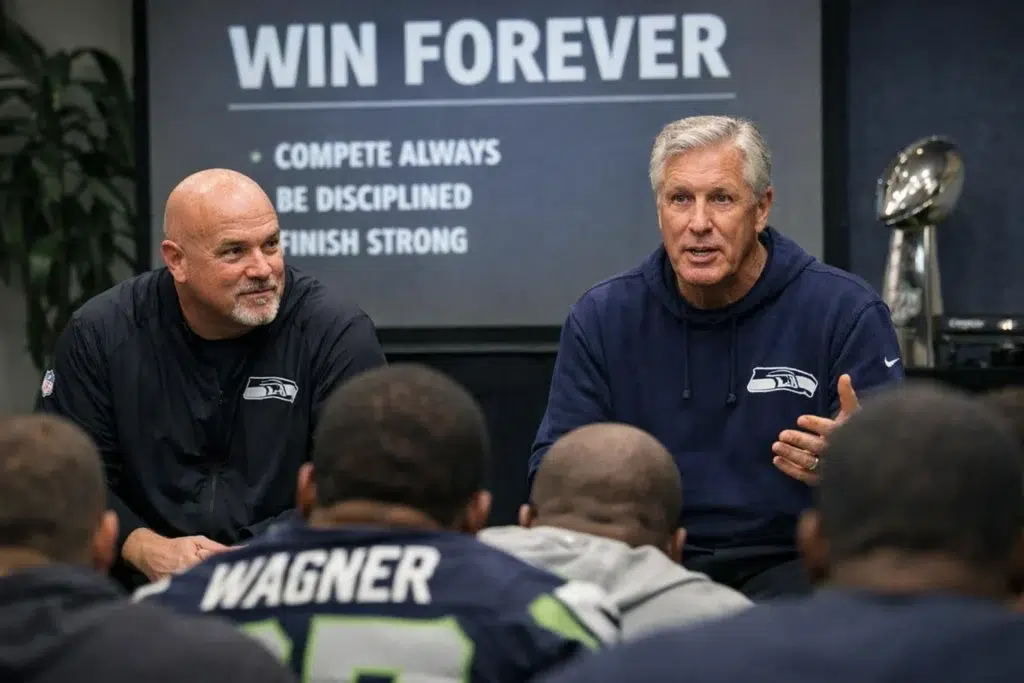
I recently sat down with NFL strength coach Chris Carlisle in 🎙️ Episode [27] of the Business Superfans® Advantage podcast. Chris is the only coach in football history to have won championships at every level of competitive football — high school, junior college, major college, and the NFL Super Bowl with the Seattle Seahawks. When we talked about culture, he made a statement I have not stopped using: “If teams don’t win, it’s because of culture.” Not talent. Not budget. Not the market. Culture.
When Chris was on Pete Carroll’s staff at USC and Seattle for 18 consecutive years, one thing defined the organization above everything else: the message never changed. Same stories. Same three rules — protect the team, be early, no complaining. Same style description at the start of every season. Same opening meeting, year after year, for 18 straight years.
Chris kept meticulous notebooks. If you opened any of them from any season across those 18 years and turned to the first page, you would find the same content. Not because Carroll was inflexible. Because he understood something most leaders miss entirely.
The roster changed every year. New players needed to hear the culture. Veterans needed to be reminded. Consistency is not repetition for its own sake. Consistency builds trust. And trust is the activation mechanism for everything that follows.
Chris then described what happened the year after Tennessee won a national championship. The head coach introduced a new concept — called it the “synergy stick.” Nobody in the building fully understood what it meant. People took it in different directions. The culture fragmented. The same talented roster that had just won a national title lost its identity in a single season. The message had changed. Trust eroded. Results followed.
In the Business Superfans® methodology, every growth outcome — Recognition, Retention, Reputation, Reviews, Referrals, Revenue — runs through the R⁶ Reactor™. Every stage of that sequence is downstream of the stakeholder relationship. And the stakeholder relationship begins with a felt experience.
That felt experience is culture. And culture is what triggers the first stage of the R⁶ Reactor™: Recognition. When every person who represents your business — whether an employee, a contractor, a VA, or a vendor partner — operates from a clear, repeated culture, they recognize clients and partners in a way that feels intentional rather than accidental. That recognition makes people feel seen. People who feel seen become loyal. Loyalty becomes reputation. Reputation generates reviews. Reviews generate referrals. Referrals generate revenue.
The entire compounding sequence of the R⁶ Reactor™ starts with whether your culture is clear enough, repeated enough, and embedded deeply enough for every person in your ecosystem to deliver it consistently — without you standing over their shoulder every day.
A consistent business culture creates Business Superfans® by giving every person in the ecosystem — employees, contractors, clients, and partners — a reliable, repeatable experience that they recognize as distinctly yours. When that experience is positive and consistent, people become advocates without being asked. The Business Superfans® methodology developed by Frederick Dudek (Freddy D) identifies cultural consistency as the non-negotiable starting point of stakeholder advocacy — not a marketing campaign, but a delivery system that performs the same way every time, with every person who interacts with the business.
Most business owners have unwritten culture rules that live in their heads and never reach the people who need them. Chris described this pattern from his work with small businesses: owners who have been operating for five to ten years and assume their culture is obvious — only to find their team is making it up as they go. This is just as true for a solopreneur whose contractor is delivering work to clients and whose VA is fielding inquiries as it is for a business with twenty employees. The question is the same in both cases: does every person who touches your business know exactly what it stands for — and how it shows up?
Define the non-negotiables first. Pete Carroll had three rules. Not thirty. Three. Protect the team. Be early. No complaining. Each rule was behavioral — something observable on any given day. Not a value. Not an aspiration. An operational standard.
Then repeat the message at every level in the language that fits that level. Chris made an important distinction: do not make parrots. The leader sets the message. Each layer of the organization tells the same story in their own words. When the third-in-command can articulate why the business does what it does in their own language — without distorting the meaning — the culture is embedded.
Measure consistency through the client experience. Not surveys. Walk the interaction from first contact to first invoice. Does a client who worked with your business six months ago get the same felt experience as one who worked with you last week? If not, the culture leak is somewhere between what you believe and what your team delivers.
Business owners categorize culture as an HR issue. Revenue Architects know it is an operations issue. Inconsistent culture creates inconsistent delivery. Inconsistent delivery creates unpredictable retention. Unpredictable retention makes revenue planning impossible.
If you are chasing new clients every quarter because existing ones are not returning and not referring, the instinct is to blame marketing. The problem almost always traces back to inconsistency in delivery. And delivery inconsistency is a culture problem. One of the first things I look for when working with service businesses is the gap between what the owner believes their business delivers and what a client actually experiences on interaction three or four — after the honeymoon of the first job. That gap is exactly where Business Superfans® either get created or get lost.
The most common mistake is treating culture as a one-time exercise. The owner runs an offsite, creates a mission statement, puts it on the wall, and considers the job done. Pete Carroll told the same story for 18 years because he understood the work never finishes. Culture is a maintenance system, not a launch event.
The second mistake is confusing personality for culture. An owner who is great with people can mistake their personal charisma for a scalable delivery system. What happens when they are not in the room? For a solopreneur, the question is even more immediate: what happens when your contractor delivers work to a client, or your VA handles an inquiry? If you have never shared your standards with them, they are improvising on your behalf. If the answer to any of these questions is “things loosen up a bit,” the culture is not built — the owner is the culture. That is both a growth ceiling and a business valuation problem.
The third mistake is correcting in public. Chris was direct about this. Public corrections do not build accountability. They build apprehension. An apprehensive team does the minimum, stops taking risks, and stops going beyond what is asked. That is the opposite of a Business Superfans® culture.
Before the end of this week, write down three non-negotiable operational standards that define how your business shows up — not aspirational values, observable behaviors. Then schedule one conversation where you share those standards with the people who touch your delivery. That includes your contractors, your virtual assistant, and any vendor whose work feeds into what your clients experience. Not a memo. A conversation. That is the beginning of your championship culture — and the first signal of the R⁶ Reactor™ firing at Recognition.
The businesses that win are not the ones with the best talent. They are the ones where everyone knows exactly what they stand for, says it in their own words, and delivers it the same way every time. That is what turns a service business into a Business Superfans® operation.
→ Sign up for the Prosperity Pathway Newsletter at https://prosperitypathway.tips